
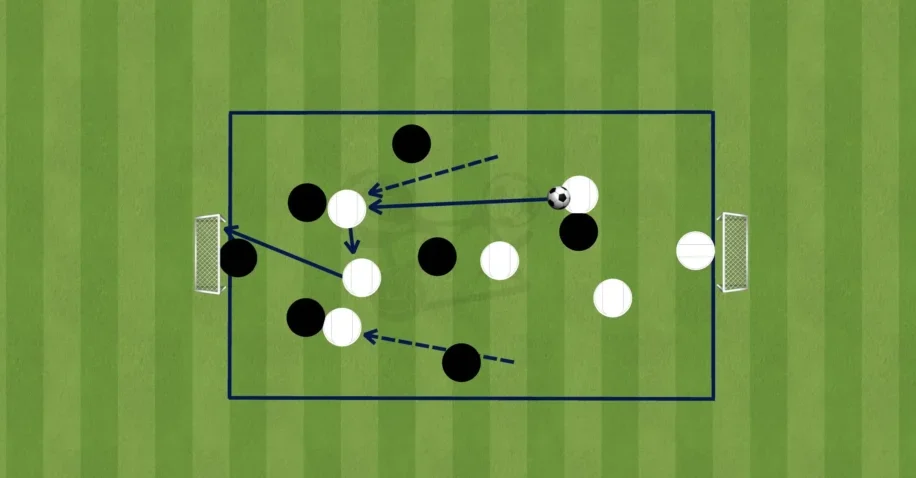
Counter-pressing is no longer a stylistic preference reserved for a handful of daring managers, it has become the spine of modern football, the shared language of elite teams who understand that the fastest way to attack is often the second after possession is lost.
The best sides in Europe squeeze space like a closing fist, hunting in packs with a kind of collective instinct that feels rehearsed yet feral, and that instinct is built on repetition, structure, and drills that teach players how to react before their doubt has time to surface.
This is a detailed guide to the best counter-pressing drills, written for coaches who want clarity rather than noise, who want step-by-step structure rather than theory floating without purpose, and who understand that pressing is not about running hard but about running together with intent.
Each drill is built around timing, angles, body shape, and communication, because counter-pressing is less about chaos and more about synchronized aggression, and every exercise below is designed to sharpen that edge until it becomes second nature.
The Philosophy of the 5 Second Rule
Before the cones are placed and the bibs are handed out, the squad must understand the internal clock that governs elite counter-pressing sides, because the difference between organized chaos and reckless chasing often lives inside a narrow window of time.
The five second rule is simple in wording and ruthless in execution, and it demands that the moment possession is lost the nearest players explode toward the ball, cutting off forward passes, blocking central lanes, and using the touchline as a silent extra defender who never tires and never hesitates.
If the ball is not recovered or forced into a hurried clearance within five seconds, the press dissolves and the team must fall into its defensive structure, because prolonged chasing drains energy and fractures shape in ways that clever opponents can exploit.
These drills are built around that window, around shrinking the pitch emotionally for the opponent, around creating the feeling that every heavy touch carries consequence and every sideways pass is a risk, and they teach players that losing the ball is not an ending but a trigger.
1. The Classic 4v2 Transition Rondo
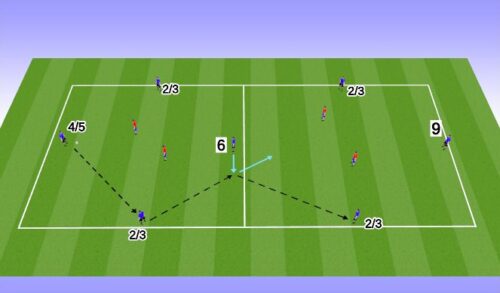
The rondo is often viewed as a tool for keeping the ball, but its true value lies in the moment the circle breaks. In a tight 10 by 10 yard grid, four attackers zip the ball around two defenders. The intensity must be high; the touches must be sharp.
The drill transforms when the two defenders intercept a pass. Instead of the play simply resetting, the defenders must immediately look to dribble through a set of small gates or pass the ball out of the square. The four attackers, who were just focused on flair and possession, must instantly collapse on the ball carrier.
How to run it:
- Set up a 10×10 yard square with four attackers on the edges and two defenders inside.
- The attackers aim for 10 consecutive passes.
- If a defender wins the ball, they have three seconds to exit the square.
- The attackers must swarm the defender to prevent the exit.
- Rotate the defenders every two minutes to maintain high energy.
CHECK OUT | 10 Best Defensive Soccer Drills For Youth Soccer Players
2. The 3v3+2 Directional Game
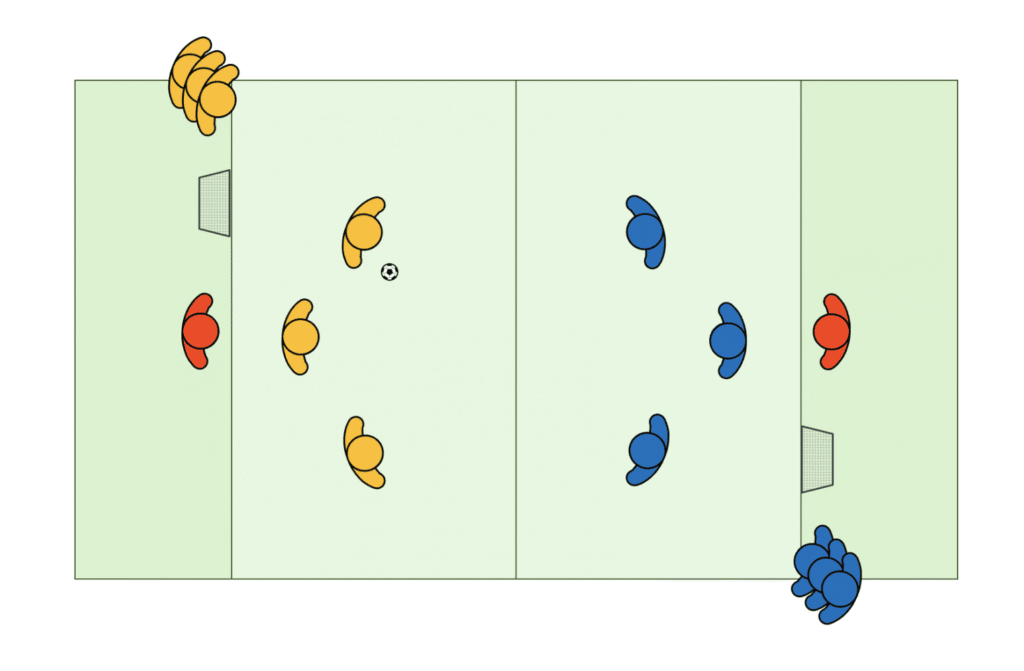
Football is a game of directions, and counter-pressing is most effective when you take away an opponent’s escape route. This drill uses a rectangular pitch with two neutral players who always stay on the side of the team with the ball. This creates a constant 5v3 overload.
The team of five moves the ball with ease due to the extra numbers. However, when the three defenders steal the ball, they have two small goals to aim for at either end of the rectangle. The five players who just lost the ball are suddenly in a crisis. They must use their superior numbers to build a “wall” between the ball and the goals.
How to run it:
- Create a 20×15 yard rectangle with a small goal on each end line.
- Assign two teams of three and two neutral “jokers.”
- The team in possession uses the jokers to maintain flow.
- Upon turnover, the three new attackers try to score immediately.
- The five losing players must close passing lanes to the goals within four seconds.
3. The Double-Square Chaos Drill
Counter-pressing often requires a long-distance sprint to prevent a “release pass.” This drill forces players to deal with physical fatigue while maintaining tactical discipline. You set up two identical squares roughly twenty yards apart. A 4v2 rondo takes place in Square A, while two resting players wait in Square B.
The moment the two defenders in Square A win the ball, they must fire a long, driven pass into Square B. The four attackers from Square A must then sprint across the twenty-yard gap to Square B and start a new press before the players there can get the ball under control.
How to run it:
- Position two 12×12 squares 20 yards apart.
- Start a 4v2 rondo in Square A.
- On a turnover, defenders pass to Square B.
- The original four attackers must sprint to Square B to hunt the ball.
- This emphasizes the “collective sprint” needed to cover ground quickly.
4. The “Hunter” Small-Sided Game
Psychology is the biggest hurdle in coaching a press. Players often feel discouraged when they lose the ball. This drill flips that narrative by rewarding the “hunt.” In a 6v6 game played on a short but wide pitch, the field is divided into thirds.
If a team loses the ball in the attacking third and wins it back within six seconds, any goal they score in that ensuing sequence counts for triple. Suddenly, the players aren’t frustrated by a lost ball; they are excited. They see the turnover as a chance to blow the game wide open.
How to run it:
- Use a pitch 40 yards long by 50 yards wide with full-sized goals.
- Mark the “pressing zone” in the final third of each end.
- If the ball is recovered in that zone, the “triple goal” rule is active.
- Encourage the goalkeeper to play short to invite the press.
CHECK OUT | 10 Skill Moves All Youth Soccer Players Must Learn
5. The 1v1 to 3v3 Wave Drill
In a real match, transitions are messy. They don’t start with everyone in a perfect circle. This drill mimics the escalating nature of a scramble. It begins with a 1v1 where a defender passes to an attacker and tries to stop them.
As soon as that ball goes out or a goal is scored, the coach immediately plays a second ball into the middle. At that exact moment, two fresh players from each team sprint onto the pitch to join the original two. The original players are gasping for air, but they must organize the press for their fresh teammates.
How to run it:
- Set up a 30×20 yard area.
- The 1v1 starts from the end line.
- On the coach’s whistle, four new players enter the field.
- The original players must “steer” the ball carrier toward their fresh teammates.
- This teaches communication under extreme physical duress.
6. The “No-Exit” Circle
This is the ultimate drill for teaching “funneling.” Many players make the mistake of running directly at the ball in a straight line, which makes them easy to bypass with a simple sidestep.
A large circle is drawn with a tiny 5-yard circle in the dead center. One player starts in the center, and six players stand on the outer rim. The outer players pass the ball across the circle. When the “hunter” in the middle intercepts it, they must try to dribble out of the large outer circle. The six players must leave their stations and converge on the center to block every possible exit.
How to run it:
- Mark a 20-yard diameter circle with a 5-yard hub.
- The “hunter” stays in the middle until they touch the ball.
- Outer players must stay on the line until the turnover.
- The goal is to teach the players to “surround” the ball rather than chasing it.
CHECK OUT | 10 Skill Moves All Youth Soccer Players Must Learn
7. The 8v4 Overload Grid
To counter-press successfully, players must understand “triggers.” You cannot press everyone at once, or you will be exhausted by halftime. This drill puts eight attackers against four defenders in a large box.
The four defenders are heavily outnumbered, so they cannot win by running aimlessly. They must wait for a trigger: a poor first touch, a player receiving the ball with his back to the field, or a slow “loopy” pass. When that trigger happens, all four must move as one unit. The eight attackers learn how quickly a “safe” possession can turn into a trap.
How to run it:
- Use a 30×30 yard grid.
- The eight attackers must stay inside but can move freely.
- The four defenders look for “technical errors” to launch their press.
- When the ball is won, the defenders must connect three passes to “win” the point.
8. The Defensive Third Escape
The most dangerous place to lose the ball is right in front of your own goal. This drill focuses on the high press. The pitch is split at the halfway line. The “attacking” team starts with the ball deep in their own half and must try to dribble or pass across the halfway line.
The “defending” team sets up high. If they win the ball within twenty yards of the goal, they get a free shot. This teaches players the value of geography. Winning the ball at the halfway line is good; winning it at the edge of the box is lethal.
How to run it:
- Use half a pitch with one main goal.
- The team playing out of the back has a 6v4 advantage.
- The 4-man pressing unit must stay compact and high.
- Focus on “cutting the pitch in half” by forcing the ball toward the touchline.
9. The Reactive Box Sprints
Counter-pressing is as much about the brain as it is about the legs. This drill removes the tactical complexity to focus on the “twitch.” Four players stand in a 10-yard box, passing the ball around at a jogging pace.
The coach shouts a specific color or name. The player who has the ball at that moment is the “target.” He must try to touch any of the four cones at the corners of the box. The other three players must react instantly and touch the ball carrier before he reaches a cone. This trains the neurological switch from “offense” to “defense” in a fraction of a second.
How to run it:
- Set up multiple 10×10 boxes for the whole squad.
- Players pass in a relaxed manner to lower their heart rates.
- The coach’s signal must be unpredictable.
- The “hunt” should last no more than three seconds.
CHECK OUT | Best Indoor Soccer Workouts for Youth Players — Train Anywhere, Anytime
10. The 11v11 Full Pitch “Three-Ball” Game
The final stage of counter-press training is handling the unpredictability of a full match. In this 11v11 scrimmage, the coach stands on the touchline with several spare balls. The game proceeds normally, but at any moment—regardless of where the ball is—the coach blows a sharp whistle and hurls a new ball into a different zone.
The previous ball is instantly dead. The players must abandon their current positions and sprint to the new ball to establish dominance. This creates a chaotic environment where no one is ever “settled.” It mimics those moments in a game where a long clearance or a sudden deflection changes the tactical landscape, forcing the team to reorganize their press on the fly.
How to run it:
- Play a standard 11v11 match.
- The coach acts as the “chaos agent,” throwing balls into difficult areas (e.g., into the corners or behind the defensive line).
- The team that reacts first and organizes their shape around the new ball usually wins the sequence.