Most players who want soccer scholarship have no idea where to begin. They know the destination, playing football and studying in the United States on scholarship but the map between here and there looks blank.
They ask around, get half-answers, watch YouTube videos that skim the surface, and end up more confused than when they started.
That confusion is not a personal failure.
The American college soccer recruitment system is genuinely complex, built over decades for domestic athletes, then gradually opened to international players who largely had to figure it out themselves. This article is the clear map that most players never find.
The Three Bodies That Run College Soccer
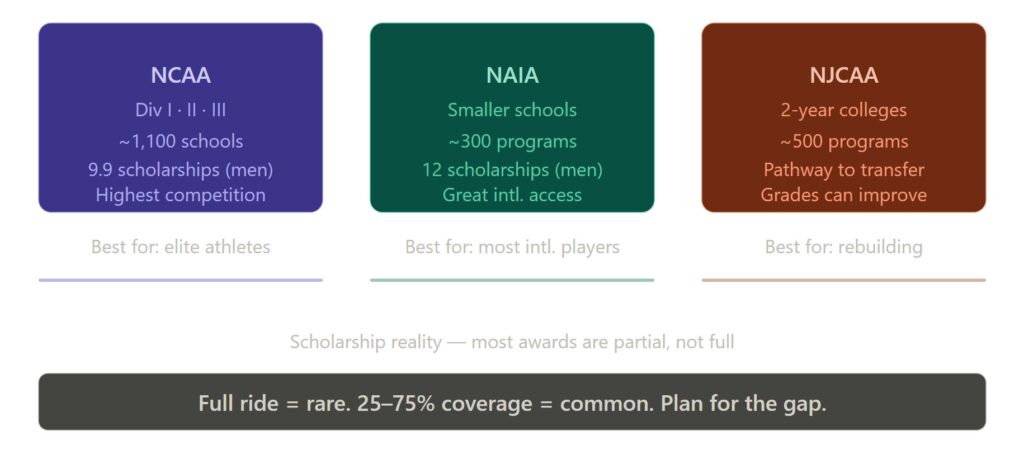
American college athletics operates under three separate governing structures, and understanding their differences is the first thing any international player needs to get right.
The NCAA is the largest body.
Its Division I programs attract the most attention, carry the biggest budgets, and field the strongest competition, many rosters include players who have represented national teams at youth level.
Division II, sitting one tier below, offers strong competition with more accessible scholarship funding and remains the realistic landing spot for a large segment of serious international players.
Division III schools offer no athletic scholarships at all, though academic merit aid can be substantial.
The NAIA serves smaller institutions and is often where international players find their smoothest path in. Coaches at NAIA schools tend to move faster, recruit more actively from abroad, and carry more scholarship slots relative to roster size. The competition level is serious without being the bruising gauntlet of Division I.
NJCAA covers two-year community colleges.
For a player whose grades need strengthening before a four-year program, or who simply wants to assess whether college football suits them before a longer commitment, starting at a junior college and transferring after two years is a legitimate and well-worn route.
One truth runs through all three: most scholarships are partial.
A typical Division I men’s program distributes 9.9 total scholarships across a squad of 25 to 30 players. The math makes full rides a rarity. Going in with clear financial expectations and planning for what the scholarship does not cover — matters as much as the football.
CHECK OUT | 7 Proven Ways to Get Recruited for College Soccer from High School
What Coaches Are Actually Evaluating
Before a coach invests scholarship money in an international player they have never seen in person, they need to be satisfied on three fronts simultaneously: academic eligibility, athletic quality, and position value.
All three carry weight. Weakness in any one of them stalls the process.
On the academic side, the minimum GPA for NCAA eligibility sits around 2.3 on a 4.0 scale for Division I, though most schools want higher than that for genuine admission.
Language proficiency is non-negotiable for non-native speakers = IELTS 6.0 or TOEFL iBT 79 are common minimum thresholds, with competitive programs expecting higher. These tests take time to prepare for and should be scheduled well in advance of application deadlines.
Athletically, coaches are reading two things simultaneously: the quality of your play and the level at which you have been playing. A technically accomplished player from a nationally competitive club tells a more convincing story than the same skill set in a low-level local competition.
Club structure, league level, and whether opponents were genuinely challenging all factor into how a coach interprets what they see on your highlight video.
Position matters structurally. Goalkeepers carry particular value because squads carry so few of them, a technically sound keeper who distributes well with their feet, something American youth development has historically underproduced, can find open doors where an equivalent outfield player cannot.
Central defenders with good reading of the game, disciplined midfielders who defend as hard as they create, and wide forwards with pace in transition are consistently in demand across all divisions.
CHECK OUT | NIL In College Soccer: Here’s What You Need To Know
Building Your Case Before You Make Contact
Two things need to exist before you email a single coach: a football CV and a highlight video. Everything else in the process depends on having these ready.
Your CV should be a single, clean document. Name, nationality, date of birth, height, weight, position, dominant foot. Current club, league level, and how many seasons you have played there. Recent season statistics; appearances, goals, assists, clean sheets for goalkeepers.
Academic details — GPA equivalent, school attended, expected graduation year, language test scores. Contact information. Nothing else. Keep it to one page if possible. Coaches read these in seconds.
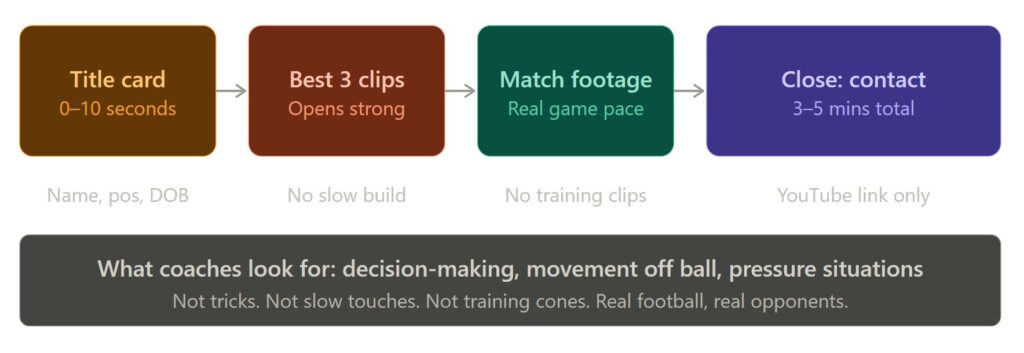
The highlight video is where most players either win or lose a coach’s attention before they have exchanged a single word. The structure matters enormously.
Open with your three strongest moments. Not a slow montage, not a title card that runs for forty seconds; your best football, immediately.
Coaches receive hundreds of videos and close the ones that take too long to show something worth watching. The full video should run between three and five minutes.
Everything on it should be match footage against real opponents, not training ground skill exercises. Upload it to YouTube and keep the link instantly clickable, no file attachments, no access-request prompts.
What coaches want to see is intelligence, not entertainment.
First touch under pressure, movement before the ball arrives, reading of defensive shape, how you behave in the final third when the ball is not at your feet. Flair is fine if it comes with substance. Flair without substance is identified quickly.
Contacting Coaches: The Exact Structure That Gets Read
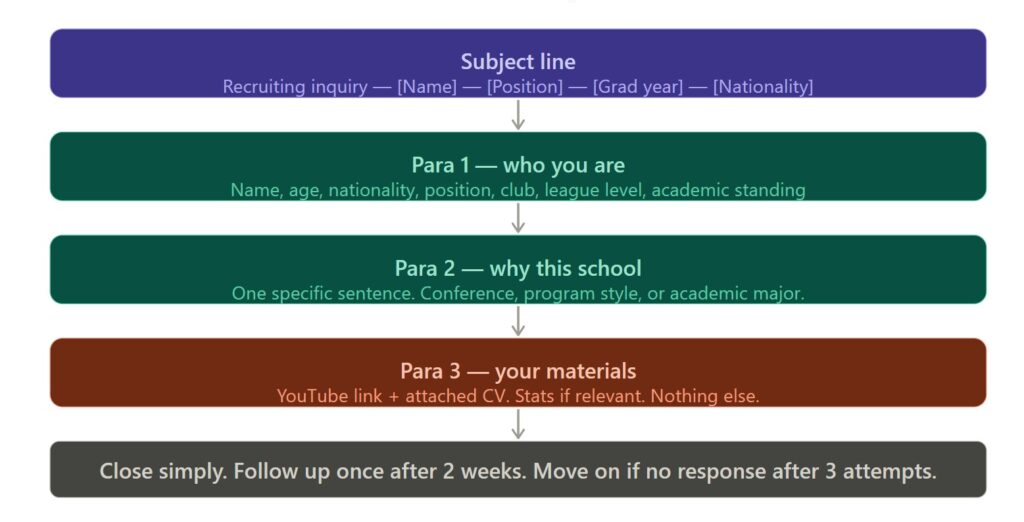
This is where more talented international players stall than anywhere else. The football ability exists. The highlight video exists. The email either opens a door or disappears into a coach’s inbox unread.
The subject line needs to tell the coach exactly what the email is before they open it. Include your name, position, graduation year, and nationality, coaches searching for a specific profile can find yours immediately.
The body should be short enough to read in 90 seconds.
The first paragraph covers who you are: name, age, nationality, current club, league level, position, and a one-line note on your academic standing.
The second paragraph is where most players miss an opportunity; they either write nothing about the specific school or copy a generic line across every email.
Write one genuinely specific sentence.
Mention something real about their program: the conference they compete in, a playing style you read about, an academic department relevant to what you want to study. Coaches read hundreds of mass emails. Specificity is immediately visible and immediately appreciated.
The third paragraph should be just links. Your YouTube highlight reel. Your CV as an attached PDF. Any recent statistics worth noting.
Nothing else.
No essays about how much you love football, no requests asking what scholarships are available. Let the footage speak.
Follow up once after two weeks if you hear nothing. A second follow-up a month later is reasonable. After that, the absence of response is an answer, and your energy belongs elsewhere.
CHECK OUT | How to Build Confidence on the Soccer Field: Proven Tips for Players
Where Else to Build Visibility
Direct outreach is the spine of the process, but recruiting platforms and social media extend your reach to coaches who might find you before you find them.
BeRecruited, NCSA Athletic Recruiting, and SportsRecruits all allow players to create searchable profiles that coaches actively browse when looking for players who fit specific criteria.
A complete profile with academic information, position, graduation year, highlight video, and club history can surface in a coach’s search for exactly the profile you represent. A half-filled profile with no video attached tells a coach nothing and costs you a potential contact.
On social media, a clean Instagram or X account dedicated to your football serves as an informal portfolio. Post match clips and training moments that show your quality. Tag your club, tag any trials you attend, make your name searchable and your ability visible.
Coaches and their assistants do browse social media, particularly when a player’s name comes up in conversation.
Your YouTube channel, even if it only contains your highlight video, matters for discoverability. Name the video with your full name, position, club, and graduation year.
Make it findable by search. An unlisted link sent in emails serves immediate outreach; a public video serves long-term discovery.
Understand What The Scholarship Covers
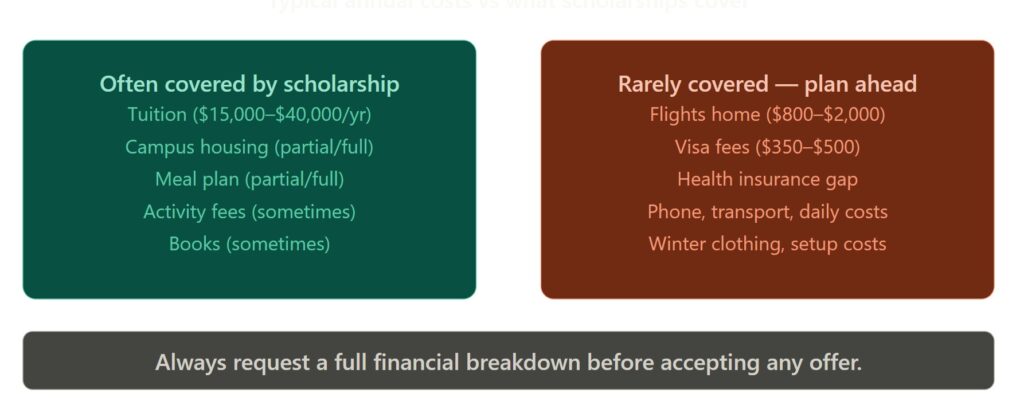
Understanding what a scholarship actually covers and what it does not prevents painful surprises after an offer arrives.
When an offer arrives, ask the school for a line-by-line financial summary. What exactly does the scholarship cover in dollar terms for the coming academic year?
Is the amount guaranteed across all four years, or subject to annual review based on performance or GPA? Are there conditions attached minimum grade requirements, continued roster position?
International students on F-1 visas face restrictions on off-campus employment. The assumption that you can work on the side to cover gaps is not reliable.
Your scholarship and any family support need to account for the full reality of living costs, not just the tuition line.
Mistakes That End the Process Before It Gets Going
Applying to only 3 or 4 schools and treating each rejection as proof the process failed. The recruitment process involves rejection at every level. A wide application net fifteen to twenty-five programs across different divisions is protection against the inevitable nos.
Sending the same word-for-word email to two hundred programs. Coaches recognize mass outreach instantly. The programs worth attending are run by coaches who notice when someone has actually looked at their school.
Overestimating your division level. A player who genuinely fits Division II but spends two years exclusively targeting Division I programs has wasted the best window in their recruitment timeline. Be honest about your level.
A Division II career where you play every week develops you. A Division I bench does not.
Letting academics slide on the assumption that football ability compensates. It does not. Academic ineligibility removes you from the process entirely, regardless of how good the footage is. A coach who wants you cannot help you if you cannot be admitted.
Starting too late. The process of contacting coaches, building a relationship through correspondence, getting an offer, applying to the school, receiving acceptance, filing for a visa, and organizing travel takes twelve to eighteen months when done properly.
Beginning in the final year of secondary school under deadline pressure produces rushed applications and missed opportunities.
CHECK OUT | How Much Should You Charge for Private Soccer Coaching?
A Timeline to Work From
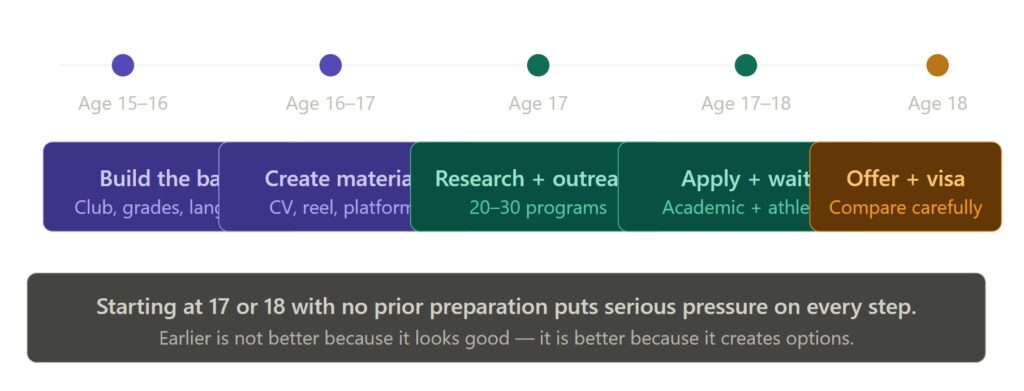
Starting between 15 and 18 gives you enough runway to do this properly.
At 15 or 16, the work is foundational: find the most competitive club environment available, maintain academic consistency, start preparing for language tests if relevant.
At 16 or 17, build the materials, produce the highlight reel, write the CV, set up profiles on recruiting platforms.
At 17, start researching programs and writing to coaches. At 17 to 18, submit formal applications and allow correspondence with coaches to develop naturally. By 18, offers, acceptances, and visa processing should be the active work.
This is not the only sequence that produces results. Some players start later and still find their way through. But this pace removes the pressure that makes later starters cut corners on the video, on the school research, on the application quality.
SEE ALSO | How to Be the Best Soccer Parent: Support, Motivate & Inspire Your Child
What Separates Players Who Get There
It is almost never purely the football. Players with similar ability regularly have very different outcomes from this process, and the difference is almost always in how they conducted themselves off the pitch.
The ones who get scholarship offers play in competitive environments, contact coaches with professionalism and specificity, apply broadly rather than gambling on a narrow list of preferred schools, keep their academics clean, and stay patient through a process that can take eighteen months before an offer materializes.
The ones who do not are often waiting — waiting to be discovered, waiting for someone else to initiate contact, waiting until their final year when time runs out.
Or they are playing in a weak competition level and wondering why coaches are not responding enthusiastically. Or they sent forty identical emails and interpreted the silence as evidence that the opportunity does not exist for someone like them.
The opportunity exists. The pathway is genuinely open to international players from any country, at any level that produces honest competitive football. What it requires is not exceptional talent alone, it requires exceptional preparation paired with the talent you have.
That combination, applied consistently, over enough time, produces the outcome most people assume is reserved for someone else.