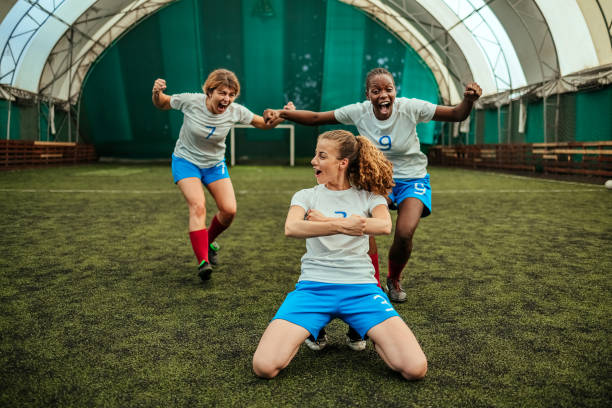
Most players spend their entire week trying to stay on their feet, yet the moment the ball crosses the goal line, the only logical response is to abandon balance and let a perfectly timed slide across the damp grass do the talking.
It is a strange, beautiful physics experiment that defies the traditional laws of self-preservation. One second you are an elite athlete with a meticulously maintained skeletal structure, and the next, you are a human sled testing the friction coefficients of a multi-million dollar pitch.
This is not just about the aesthetics of the slide. It is the definitive punctuation mark at the end of a high-stakes sentence.
While the tactical analysts are busy charting passing lanes and heat maps, the striker is busy charting the smoothest path toward the corner flag. To the uninitiated, it looks like a reckless gamble with one’s patellas, but to those who have felt the cool spray of turf water against their shins, it is the only way to properly exhale.
It is where the grit of the game meets the grace of the celebration, turning a simple patch of dirt into a stage for the ultimate display of sporting theater.
The Mechanics of it
At its core, a perfect knee slide is a feat of physics. To pull it off without ending up with a shredded pair of shorts or a trip to the treatment room, a player needs three specific variables to align: velocity, moisture, and weight distribution.
The velocity is the easy part. Most goals are preceded by a sprint, and that momentum is what carries the player across the grass.
But the moisture is where the magic happens. On a dry pitch, friction wins.
If a player tries to slide on a parched surface, their knees will grab the grass, their torso will whip forward, and they will likely perform an accidental somersault that ends in embarrassment. This is why you often see groundsmen dousing the pitch with water just minutes before kickoff or even during halftime. It isn’t just for the speed of the ball; it provides the lubrication necessary for the theatrics.
The weight distribution is the final piece of the puzzle. A player doesn’t just drop straight down. They lean back, shifting their center of gravity behind their knees.
This creates a sled-like effect. By tilting the torso toward the heels, the player reduces the downward pressure on the kneecaps, allowing them to skim across the blades of grass rather than digging into the soil. When done correctly, a player can travel fifteen or twenty feet, arms outstretched, looking like they are floating on a green sea.
CHECK OUT | 10 Skill Moves All Youth Soccer Players Must Learn
Where It All Started
Tracing the exact origin of the knee slide is like trying to find the first person who ever decided to kick a ball. However, the move gained its cultural footprint in the late 1970s and early 1980s. Before then, celebrations were often polite affairs a firm handshake, a pat on the back, or perhaps a modest leap into the air.
The shift happened as the game became more televised and more individualistic. Players started to realise that the moment after a goal was their time to own the frame.
Many historians of the game point to the German legend Jürgen Klinsmann as the man who refined the art of the ground-based celebration, though his was often more of a full-body dive.
But the true, upright, chest-out knee slide found its home in the English Premier League during the 1990s. This was an era of heavy rain, lush pitches, and big personalities like Eric Cantona and Thierry Henry.
Henry, in particular, turned the knee slide into an icon. His slide against Tottenham Hotspur in 2002 was so perfect that Arsenal eventually immortalized it in bronze. The statue outside the Emirates Stadium isn’t of Henry kicking a ball; it’s of him mid-slide, knees buried in the North London soil, a look of calm defiance on his face.
The Meaning Behind the Move
Why do they do it? The answer is simpler than you might think. Soccer is a game of immense physical tension. You spend 90 minutes sprinting, jostling, and being kicked. When the ball finally hits the net, that tension has to go somewhere.
- The Release of Power: Sliding allows a player to maintain their speed while transitioning into a state of rest. It feels like flying without leaving the ground.
- The Alpha Stance: There is something inherently dominant about the posture. A sliding player is upright, their chest is expanded, and they are moving toward the fans. It says, I did this, and you are all here to watch it.
- The Camera Angle: Players are more aware of the lens than ever before. A standing celebration can be messy, with teammates crowding the view. A slide creates distance. It allows the photographer to capture the individual in a clean, heroic frame.
CHECK OUT | 10 Best Defensive Soccer Drills For Youth Soccer Players
The Evolution of the Surface
The knee slide hasn’t always been the standard. If a player tried this in the 1970s, they would have likely ended their career on the spot.
The pitches of the past were often mud baths in the winter and hard-packed dirt in the spring. There was no “gliding” on the craters of the old Baseball Ground or the sandy patches of a mid-season Highbury.
The rise of the knee slide corresponds almost perfectly with the technological revolution in stadium turf. Today, top-tier pitches are hybrid systems.
They are roughly 95 percent natural grass stitched together with millions of synthetic fibers. These fibers provide a stable root zone that doesn’t tear away when a stud or a knee digs in. Because the ground is more predictable and the drainage is so efficient, groundskeepers can keep the surface slicker than ever before.
The introduction of Desso GrassMaster and similar systems changed the aesthetics of the celebration.
Players realized they could trust the ground. They knew that if they hit the deck at the corner flag, the turf wouldn’t give way or catch them in a hidden divot. It turned the pitch into a stage, and the knee slide became the preferred way to take a bow.
The Psychological Release
Beyond the physics, there is a deep psychological reason for the slide. Soccer is a sport of low margins and high frustration. A striker might spend 89 minutes being kicked, marked, and heckled, only to find one second of space to score. The knee slide is a literal grounding of all that pent-up energy.
It is a way to bridge the gap between the player and the supporters.
By lowering themselves to the ground, players bring their eye level closer to the fans in the front rows. It is an intimate gesture despite being performed in a stadium of eighty thousand people. There is a sense of surrender in it.
The player is so overwhelmed by the moment that they can no longer stand on their own two feet.
This is why the slide is rarely seen after a 5th goal in a 5-0 blowout. It is reserved for the winners, the late equalizers, and the derbies. It is a visual representation of a weight being lifted.
When Didier Drogba or Thierry Henry do this toward the cameras, it wasn’t just about looking good. it was about claiming the territory. They were marking the grass as their own.
The Cost of the Celebration
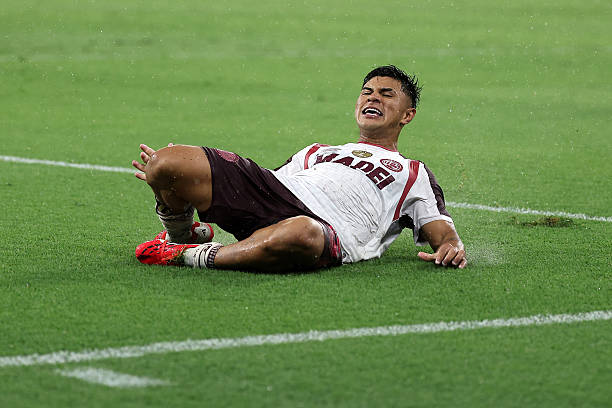
While it looks effortless, the knee slide carries a genuine risk of injury.
The most common casualty is the skin itself. Even on the best-manicured pitches, grass burn is a constant reality. These burns are often deeper and more painful than they look, frequently becoming infected because of the bacteria found in the soil and fertilizers.
Many players now wear specialized leggings or “sliders” under their shorts that have reinforced padding or low-friction fabrics to prevent these abrasions.
Others have learned the hard way that certain types of turf are less forgiving. Arjen Robben once famously complained about a celebration that left his knees bloodied and bruised, leading him to rethink his post-goal routine.
Then there is the risk to the joints. If the grass is too “tacky,” the sudden stop can put immense strain on the Anterior Cruciate Ligament (ACL) or the meniscus.
There have been several documented cases of players missing the next match because they celebrated too hard. Managers often cringe when they see their multi-million dollar assets sliding toward the hoarding, knowing that a single caught stud could result in a six-month layoff.
In 2014, the Algerian player Sofiane Feghouli provided a cautionary tale when his attempt at a slide went wrong during a match, leading to a visible limp.
More recently, some clubs have reportedly held informal discussions with players about “safe” celebrations, though trying to tell a player how to react after scoring a last-minute goal is like trying to tell a thunderstorm where to strike.
CHECK OUT | What to Pack for Summer Soccer Camp: Must-Have Items for Players
The Masters of the Sliding Celebration
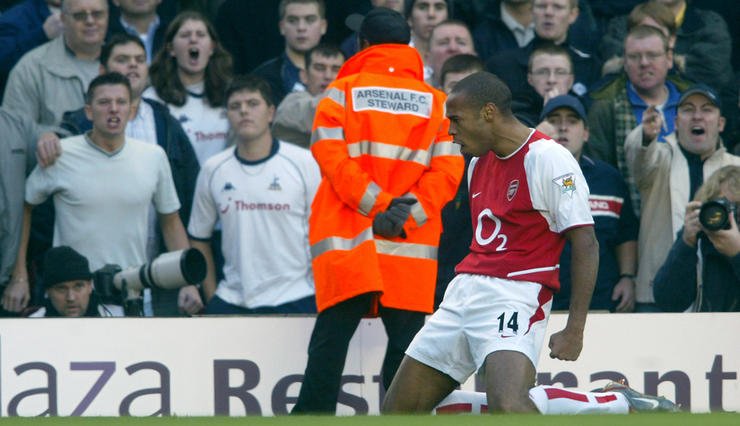
Every era has its masters of the craft. Thierry Henry brought a certain Gallic shrug to the slide. He would often slide to a halt and simply stare at the crowd, motionless, as if to ask them if they were not entertained. His slide at Highbury against Tottenham was so iconic it was eventually immortalized in bronze as a statue outside the Emirates Stadium.
Then there is Ole Gunnar Solskjaer, whose winning goal in the 1999 Champions League final was followed by a slide that he later blamed for aggravating a knee injury that plagued the end of his career. It was a moment of pure instinct that came at a heavy price.
In the modern game, the slide has become more choreographed. Some players use it as a setup for a secondary move, like a finger-to-the-lips gesture or a salute.
Others, like Kylian Mbappe, have used the momentum of the slide to transition into a folded-arm pose that has become a brand in itself. The slide is no longer just the end of the play; it is the beginning of the highlight reel.
The Cultural Impact
The influence of the knee slide extends far beyond the professional leagues. Go to any local park on a Saturday morning, and you will see children attempting the same move. It has become the universal language of scoring. I
n video games like FIFA and EA Sports FC have spent thousands of hours motion-capturing the perfect slide, ensuring that the virtual blades of grass kick up in exactly the right way when a player hits the trigger button.
This cultural ubiquity has made the slide a part of the game’s fabric. It is the image used on billboards, the silhouette on clothing brands, and the go-to photo for newspaper back pages.
It captures the essence of the sport: speed, grace, and a touch of danger.
How To Slide On Your Knees After Scoring

A knee slide is one of the most natural movements in soccer, but there’s a knack for getting it right.
Getting it wrong will only mean you’re going to land flat on your face, but after scoring the all-important goal for your team, the last thing you want to do is chew turf.
Step 1: Pitch Conditions
If the pitch is bone-dry, then sliding isn’t going to be as easy; mild conditions are fine, and wet weather is even better. You can slide on a warm, sunny pitch, but the grass has to be in good condition.
If there are parts of the pitch where the earth is showing, avoid sliding there.
Artificial grass looks great, lasts for years, and doesn’t need cutting, but it’s usually too dry to slide on easily, so ideally, you’ll want to stick to sliding on natural grass.
Step 2: The Run Up
The faster you’re going when you make a knee slide, the further you’ll slide along the pitch. After scoring, sprint as quickly as possible towards a corner flag, and once you’ve hit top speed, make sure you’ve got enough runway left to make your landing.
Step 3: Bend The Knee
You’ll find it easier to start sliding with your stronger leg, which is often the one you’re more comfortable with. In the same way a person can be left-handed or right-handed, most people are predisposed to use one leg over another.
At full speed, start bending your knee until it’s ready to hit the turf.
Step 4: Bring The Other Knee Down
As soon as your stronger leg is in position, immediately drop your other knee too. You’re aiming to hit the grass with both knees almost simultaneously. It takes a little practice, but it’s an easy celebration to learn.
You’ll find that sliding on one knee means you’ll either get tangled up in your trailing leg or your knee pushes into the ground like a spear; either way, you’re heading for a face in the dirt.
Step 5: Point Your Toes Away From You
Once you’ve hit the ground, point your toes backward, this stops your feet from acting like anchors and keeps your leg perfectly straight. From the tip of your toes right up to your kneecap, you should now be kneeling as if you’re sitting on a sled.
Step 6: Slide Like A Pro
As long as you’ve maintained your speed and both knees hit the ground at roughly the same time, you’ll now be sliding along the grass. It’s always a fun idea to practice this maneuver before games; you don’t want to ruin a perfectly good celebration knee slide.
Alternatives To Sliding On Your Knees
Cartwheels were once a favorite, and backflips have been attempted, although you’ll rarely see a manager look impressed with either. There’s hell to pay for a player who scores a vital goal and then gets themselves injured during the celebrations.
Until it was banned, players would take off their jerseys, running around the pitch waving their club colors wildly, often throwing the jersey into the crowd.
Doing that in the modern game will only end in tears; it’s a straight yellow card for the player that removes their jersey, and if they’ve already received a yellow, it’s an early bath as a red card is shown.
Another firm favorite is the baby celebration, though this is only applied when a team member has either recently had a child or is imminently expecting a birth in their family. The players line up, rocking their arms as if cradling a baby, often making sure they’re standing in front of the new or prospective parent.
Some teams go all out when celebrating a goal and come up with a unique and memorable celebration. The fans love to see these kinds of choreographed celebrations, though the referees, and often the managers, are less impressed.
CHECK OUT | Breast Binding in Women’s Soccer: Benefits, Risks, and Best Practices
Will The Knee Slide Celebration Continue
As we look toward the future, the knee slide faces new challenges. The increasing use of fully synthetic 3G and 4G pitches at the lower levels of the game makes the slide almost impossible.
Synthetic grass is made of plastic fibers and rubber crumb; sliding on it is a recipe for a “turf burn” that can take weeks to heal. As more clubs move toward these surfaces for training, the muscle memory of the slide might start to fade at the grassroots level.
However, in the cathedral-like stadiums of the Premier League, La Liga, and the World Cup, the grass will always be real, and the water will always be plentiful. As long as there is a slick surface and a goal to be celebrated, players will continue to risk their knees for that perfect, floating moment of glory.
There is something inherently human about the slide. It is an imperfect, messy, and slightly reckless way to say that something incredible has happened. It defies the modern trend of over-analyzing every aspect of the game.
You cannot quantify the joy of a knee slide in an “Expected Goals” metric. It is a purely emotional response to the hardest task in sports.
When the ball hits the netting and the roar of the crowd begins, the player isn’t thinking about their ACL. They are thinking about the 15 feet of grass in front of them and the chance to fly, if only for a second.
The knee slide remains the most beautiful way to celebrate a beautiful game. It is a nudge that at the end of the day, these players are still just kids playing in the grass, looking for a way to let the world know they won.
The Groundskeeper’s Nightmare
While the fans and players love a good slide, the people responsible for the pitch often have a different perspective. A forceful knee slide can tear up a significant chunk of turf, especially if the player’s studs catch during the process. After a particularly exuberant celebration, you will often see groundskeepers rushing out at the end of the match with pitchforks and seed, trying to repair the “scars” left by the goalscorer.
However, most groundskeepers accept this as part of the job. A scarred pitch is the sign of a game where something happened. A ckean pitch at the final whistle often means a boring 0-0 draw. The divots left by a striker’s knees are the battle scars of a stadium, and they tell the story of the 90 minutes better than any scoreboard could.