Choosing between FG and AG soccer cleats sounds simple until you stand in a sports shop staring at two pairs that look almost identical, cost the same, and promise elite performance.
The letters on the soleplate look small, yet they shape how you move, how comfortable you feel over 90 minutes, and how much stress your knees, ankles, and feet absorb across a season.
A boot that performs brilliantly on one surface can feel unstable or unnecessarily demanding on another.
Football has changed enough that this question matters more than it used to. Artificial pitches have spread across academies, schools, and training centres, while most weekend matches still happen on natural grass. A player can easily train three evenings a week on synthetic turf and then compete on grass every Saturday, which makes the old habit of buying one pair for everything far riskier than it once was.
I made that mistake myself years ago, wearing Firm Ground boots on an older artificial pitch because that was all I owned. Every sharp turn felt heavier than usual, and my knees carried a dull ache long after training ended.
I blamed the surface at the time. Looking back, the boots deserved plenty of that blame too.
What Do FG and AG Mean?
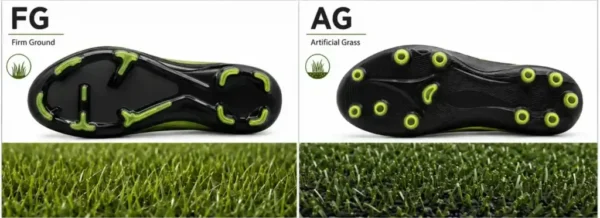
FG stands for Firm Ground and AG stands for Artificial Ground, and both describe the surface a boot has been engineered to handle safely. Firm Ground boots are built for natural grass that is dry or lightly damp, with studs shaped to penetrate living grass and soil so a player can accelerate and change direction without slipping.
Artificial Ground boots serve synthetic pitches, where plastic fibres sit over rubber crumb or sand infill and studs cannot sink into the ground the way they do on grass.
Instead they grip against the carpet and infill layer, which changes almost every movement a player makes.
Manufacturers spend years refining stud geometry and soleplate flexibility because the goal was never maximum grip.
Too little traction leaves a player sliding, while too much traction keeps the foot planted while the body keeps rotating above it, and that balance is why the letters underneath a boot matter more than most players realise.
CHECK OUT | Can Metal Studs Be Worn in Soccer? The Truth About Cleats
Why Your Playing Surface Matters
Artificial pitches now host academy sessions, school competitions, and evening leagues because they require less maintenance and stay playable in weather that would ruin a natural field.
For young players, that often means hundreds of hours a year on synthetic turf, and every sprint or sharp turn sends force from the boot through the foot, ankle, knee, and lower back.
Researchers studying football injuries note that footwear is one of the few variables players can actually control, alongside conditioning and technique, which makes choosing the right boot worth the effort.
Natural Grass and Artificial Grass Behave Very Differently
A modern artificial pitch can resemble a natural field from a distance, but the feet notice immediately.
Natural grass contains living roots that give slightly under pressure, while artificial grass sits on an engineered base that stays firmer and more consistent. That consistency helps the ball roll predictably and keeps training sessions from being cancelled for weather, but it also increases friction between studs and ground.
A stud pattern built for penetrating grass can struggle to release smoothly from turf, so during quick direction changes the foot stays engaged with the surface longer than intended, raising rotational stress on the lower leg.
Modern AG cleats exist mainly to reduce that stress without losing the grip football demands.
How FG Cleats Are Designed
Firm Ground cleats remain the world’s most popular option because the biggest competitions are still played on grass. Most share longer studs that penetrate turf effectively, fewer studs spread across the soleplate, and a mix of bladed or conical shapes depending on the model, all built for explosive acceleration and stability once the studs sink into the ground.
That same aggressive traction becomes a problem on artificial grass.
Since the studs cannot penetrate synthetic turf, they stay closer to the surface and create more resistance whenever the foot twists, which is why players often describe FG cleats on artificial pitches as feeling “stuck” during fast lateral movement.
CHECK OUT | 13 Simple Ways to Prevent Blisters When Wearing Soccer Cleats
How AG Cleats Are Built
An AG cleats can look almost identical to its FG counterpart until you turn it over.
Artificial Ground soleplates typically carry more, shorter studs spread evenly across the outsole, spreading pressure across a wider area instead of concentrating it on a few points.
That design keeps stud pressure less aggressive during long sessions, smooths out rotational movement, and improves comfort on synthetic pitches. Some manufacturers also add a touch more flexibility to the soleplate to suit turf’s firmer feel.
Players training several evenings a week often notice less foot soreness after switching from FG to AG, especially during sessions built around constant acceleration and quick changes of direction.
Why Many Players Still Buy FG Cleats
Firm Ground cleats continue outselling AG models in many markets, partly because retailers stock more of them and limited colourways often launch as FG first.
Price plays a role too, since many families would rather buy one versatile pair than two, particularly for children who outgrow boots quickly.
There is also a lingering belief that FG cleats handle every surface well enough, and in some cases they do. Plenty of players complete full seasons on both grass and artificial turf in Firm Ground boots without injury or discomfort, while others feel joint soreness after only a handful of sessions.
That variation comes down to body weight, movement patterns, and how often a player trains on synthetic turf, which is why understanding the design behind each boot matters more than relying on anecdotes.
Traction, Safety, Comfort, and Performance
Every footballer wants grip, enough to explode past a defender, plant a standing foot before striking the ball, and stay balanced under physical challenge.
The instinct is to assume more grip always helps, but football does not work that way. A cleats needs to release from the ground almost as smoothly as it grips, which is why specialists talk about rotational traction rather than raw traction.
The goal has always been controlled grip rather than maximum grip, and AG boots have evolved around that principle because synthetic surfaces create more friction than healthy grass.
CHECK OUT | How To Lace Soccer Cleats Like a Pro [2 Simple Ways]
Injury Risk
Football injuries rarely trace back to one cause.
Fitness, fatigue, previous injuries, workload, and surface quality all play a part, and footwear is simply one piece players can control. No study claims FG cleats cause injuries outright, but many sports medicine experts agree that excessive traction can raise joint stress during certain movements, particularly for players spending most of the week on artificial turf.
Modern AG soleplates were built largely to ease that stress while keeping the grip competitive football requires, a philosophy that has spread across leading brands as artificial pitches multiply worldwide.
Why Some Players Feel Knee and Foot Pain After Training
Players often blame artificial pitches for sore knees, and sometimes they are right, but sometimes the discomfort comes from what is underneath their feet.
Training three evenings a week in aggressive FG boots on synthetic turf rarely causes trouble immediately.
By the fourth week, heels ache, calves stay tight, and knees feel stiff the next morning, a gradual buildup that catches players off guard because it develops slowly.
Switching to AG cleats will not erase those symptoms overnight, but many players notice real improvement once pressure spreads across more contact points.
Performance Differences You Will Notice
The genuine differences are practical rather than dramatic. On natural grass, Firm Ground boots offer stronger penetration, excellent straight-line acceleration, and secure footing for long passes and powerful shots.
On artificial grass, AG boots offer more balanced traction over a full session, smoother rotation during turns, and reduced stud pressure.
Neither boot makes a player faster on its own; good football still comes from movement, decision-making, and practice, and the right footwear just removes unnecessary interference.
CHECK OUT | Are Soccer Cleats and Softball Cleats the Same?
Durability Depends on Where You Play Most
Artificial grass creates more abrasion than natural grass, and using Firm Ground boots exclusively on turf tends to wear studs and soleplates down faster because the longer studs face more resistance with every contact.
AG models generally hold up better since they were built with those conditions in mind, which can save on replacement costs over a season, something parents buying cleats for growing teenagers tend to appreciate.
Weather Also Changes the Equation
Firm Ground cleats perform best on dry or lightly damp natural grass where the studs penetrate as designed.
AG boots stay more consistent across most synthetic surfaces regardless of moderate weather shifts, since the pitch itself changes less than living grass does.
Problems tend to appear when FG boots meet hot, dry artificial pitches, where friction climbs and the “stuck” feeling becomes common during sharp turns.
One Pair or Two Pairs?
The honest answer depends on a player’s football calendar.
Owning both FG and AG cleats is ideal for anyone splitting time between grass matches and turf training, since neither pair carries the full workload and both perform, and last, longer as a result.
For players sticking to one pair, the sensible approach is choosing whichever boot matches the surface used most often rather than trying to make one boot suit everything.
Situations Where FG Cleats Can Still Work on Artificial Grass
This debate can get overblown online, as if stepping onto turf in FG boots guarantees injury.
That is not true.
Surface quality, stud design, body weight, and training frequency all shape the experience, so a player training on turf once every two weeks may never notice discomfort, while someone doing five sessions a week could have a very different outcome.
The more time spent on synthetic turf, the stronger the case becomes for boots built specifically for it.
CHECK OUT | Indoor Soccer Vs Outdoor Cleats/Rules (Differences)
Which Cleats Should You Buy?
The smartest purchase starts with an honest look at where a player actually spends their time, not the logo on the box.
A 9-year-old at weekend sessions has different needs from a 17-year-old training five evenings a week, and an adult in a Sunday league faces different demands than a professional with several pairs of boots at their disposal.
For young players training mostly on artificial pitches, AG soleplates usually offer better comfort during the constant direction changes of small-sided games.
If matches happen mainly on grass with only occasional turf training, FG boots remain a sensible choice, especially on a tighter budget. Comfort should always come first, since children rarely enjoy football when their feet hurt.
Academy players facing three to five sessions a week on artificial pitches should take AG boots seriously, since the benefits of reduced stud pressure and smoother rotation build up over months rather than single sessions.
Adult amateurs juggling grass and turf between work and weekends benefit most from owning two pairs if the budget allows, and otherwise should buy for whichever surface they use most.
Common Mistakes Players Make
Shoppers often choose boots based on appearance or a favourite professional’s colourway without checking which surface that player competes on.
Others assume Firm Ground works everywhere, ignore comfort during fitting, buy oversized boots expecting a child to grow into them, or keep wearing studs long after they have lost their shape.
A well-fitted boot built for the correct surface will almost always outperform an expensive boot used in the wrong environment.
How the Major Brands Approach FG and AG
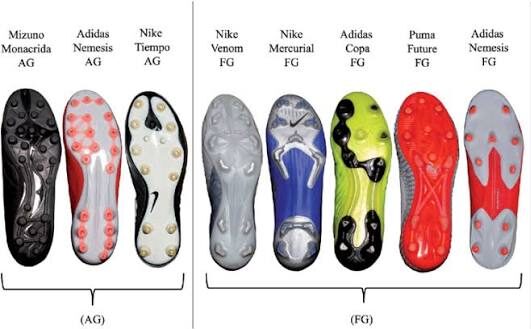
Nike, Adidas, Puma, Mizuno, New Balance, and Asics now all offer dedicated AG models across their ranges, a shift driven by years of player feedback and biomechanical research rather than marketing alone.
Across brands, the shared trends are clear: more contact points beneath the foot, smoother rotation on synthetic turf, reduced stud pressure, and soleplates built to adapt to firmer surfaces without sacrificing grip.
A Simple Buying Checklist
Identify where most of your football happens, and lean toward whichever boot matches that surface.
- Prioritise comfort over appearance,
- Buy the correct size rather than planning for growth
- Replace boots once the studs wear down.
- Rotate between two pairs if matches and training happen on different surfaces
- Fit boots with football socks, and walk and pivot during fitting instead of simply standing still.
These small details usually matter more than the price tag on the box.
CHECK OUT | How to Break in New Soccer Cleats Fast: Guide for Maximum Comfort
FAQs
Can you wear FG boots on artificial grass?
Yes, many players do, particularly on newer synthetic pitches or when they play on artificial grass only occasionally. The more frequently you train on synthetic surfaces, the stronger the case becomes for choosing AG cleats because they are designed specifically for that environment.
Are AG boots slower than FG boots?
No. Speed comes primarily from your movement, technique, strength, and decision making. AG boots are engineered to provide appropriate traction on artificial turf rather than reducing performance.
Are AG boots suitable for natural grass?
They can perform reasonably well on some firm natural pitches, although they generally deliver their best performance on artificial grass. If most of your football takes place on natural grass, FG boots remain the more appropriate choice.
Should children own two pairs?
If football forms a major part of their weekly routine and the budget allows it, owning separate FG and AG cleats offers the most practical solution.
If that is not possible, buy according to the surface they use most often.
Do expensive boots make a noticeable difference?
Premium models often feature lighter materials, improved fit, and more refined construction.
Those benefits exist, although selecting the correct soleplate usually influences comfort and performance more than spending extra money on elite level materials.