

Choosing between an elite soccer academy and a local club for your kid comes down to five things that matter far more than any league logo on the jersey: your family budget, the hours you actually have to give up on weekends, how much pressure your child can absorb before the joy drains out of the game, whether the interest driving this decision belongs to your kid or to you, and what kind of person you want walking away from the sport ten years from now.
Every parent standing at this fork in the road has heard the marketing pitch from both sides, the academy director promising a pathway to the pros and the local coach promising balance and love of the game, and most of that pitch is designed to make the decision feel simpler than it actually is.
It is not simple. The American youth soccer landscape in 2026 has more acronyms, more tiers, and more price points than it did even three years ago, and untangling MLS NEXT from ECNL from Girls Academy from your neighborhood rec league takes real effort before you can make a call that fits your family rather than someone else’s brochure.
What follows is a grounded look at what each path actually costs, demands, and delivers, built from where the system stands right now rather than where it stood when older siblings went through it.
What “Elite” Means
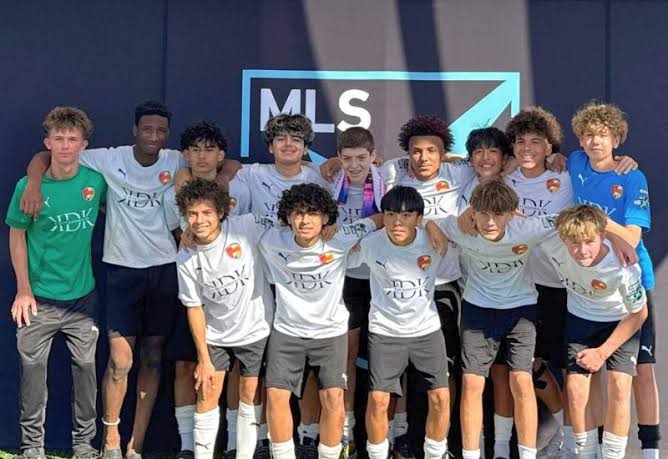
The word elite gets thrown around by nearly every club in America, so it helps to know what sits at the actual top of the pyramid before deciding whether your family belongs there.
MLS NEXT is the boys’ pathway created in 2020 after the U.S. Soccer Development Academy folded, and it functions as the direct pipeline into MLS academies, with 29 professional clubs running their own development systems inside it.
Being accepted into any MLS academy places a player in roughly the top one percent of youth soccer talent in the country, and those specific programs are often free once a child makes the roster, since MLS clubs treat academy development as an investment in future transfer value and Homegrown contracts rather than a revenue line.
ECNL sits alongside MLS NEXT as the other major tier, founded in 2009 for girls and expanded to include boys in 2017, and it has built the strongest college recruiting infrastructure of any youth platform in the country.
Coaches from hundreds of college programs, across every division, show up at ECNL national showcases specifically to watch these games, which makes it the more natural home for a family whose long-term goal runs through a college scholarship rather than a professional contract.
Girls Academy, created the same year as MLS NEXT, partners with the men’s pathway and US Youth Soccer to serve as the top rung for girls chasing a more direct professional route, though it remains newer and less proven for recruiting purposes than ECNL’s girls division, which has now had roughly sixteen years to build relationships with college staffs.
Below these three sit strong regional leagues like NPL, EDP, and various state-level premier divisions, and this is where most competitive families actually spend their years, whether or not the top tier ever enters the conversation.
None of this changes the core truth that a talented kid with a genuinely excellent local coach will often develop faster and happier than a middling talent grinding through an elite system built for players a tier above them.
CHECK OUT | Why Girls Drop Out of Soccer During Puberty
The Budget
Cost is where most families start and where most families get the math wrong, because the sticker price on a club’s website rarely resembles what actually leaves your bank account by June.
ECNL participation runs around eight thousand dollars a year once travel, hotels, and tournament fees get folded in, and that figure holds fairly steady across regions even though club-to-club registration fees vary.
MLS NEXT presents a strange split: the academies directly run by MLS professional clubs are frequently free or heavily subsidized for the handful of kids who make those rosters, while non-MLS clubs competing in the same league can run costs comparable to ECNL, sometimes higher once travel to national showcases enters the picture.
The geography of the sport plays a bigger role in your final bill than most parents expect going in.
A top ECNL or MLS NEXT roster spot in a major metro can run eight thousand dollars, while that same club’s second or third team, often coached by the same staff using the same training methodology, can run three to four thousand with a realistic path to move up if the player develops.
Clubs would generally rather offer a family a discount than watch a promising kid walk to a rival down the street, and financial aid pools exist at far more clubs than actually advertise them, so asking directly before writing off a program on price alone is worth the slightly awkward conversation.
Local and recreational clubs sit in an entirely different financial universe, often landing in the two hundred to eight hundred dollar range for a full season once uniforms and league fees are counted, with travel limited to nearby fields rather than flights and hotel blocks.
The hidden costs of the elite path extend well past the registration line anyway: private training sessions, video analysis subscriptions, ID camps, showcase entry fees, gas, missed workdays, and the quiet toll of a family reorganizing its entire calendar around one child’s tournament schedule.
Before signing anything, ask a club for the full-year estimate rather than the headline number, because a program that looks affordable on paper can become the most expensive option once a heavy travel schedule gets added in.
Time, Travel, and What It Costs Your Family
Money is the easier number to calculate.
Time is the one soccer parents underestimate until they are three months into a season driving ninety minutes each way to a Tuesday practice on a school night. Elite academy soccer at the MLS NEXT or ECNL level typically means four to six training sessions a week, weekend tournaments that eat entire Saturdays and Sundays for months at a stretch, and travel showcases that can mean flights and hotel stays several times a season depending on region.
For a family with one soccer-playing child, that schedule is demanding but manageable for a parent willing to build life around it. For a family with two or three kids in different activities, or with parents working jobs that do not bend easily around a 4pm Tuesday training slot, the math stops working long before the season ends.
Local clubs, by contrast, generally ask for two to three practices a week and games within driving distance, which leaves room for siblings, family dinners, and the kind of unstructured childhood that used to be the default rather than the exception. This is not a small tradeoff.
A 2026 review of youth participation trends found the average young athlete today plays only about 1.63 sports, down sharply from a generation that grew up bouncing between three or four seasonal activities, and much of that narrowing traces directly back to schedules that no longer leave room for anything else.
A kid locked into six training sessions a week for soccer alone has, by definition, lost the calendar space to try basketball in the winter or track in the spring, and that narrowing carries real costs to overall athletic development that youth sports researchers have been documenting for years.
CHECK OUT | How to Build an Amateur Football Scouting Database That Works
The Stress
Every parent worries, quietly or out loud, about pushing a kid too hard too early, and the research on this gives a more layered answer than either side of the debate likes to admit.
A 2025 study on adolescent athletes found that specialized players reported significantly higher emotional and physical exhaustion than their non-specialized peers, along with elevated scores on the devaluation dimension of burnout, meaning kids in single-sport intensive programs were more likely to grow cynical about a sport they once loved.
Longitudinal work tracking the same athletes from seventh through twelfth grade found participation dropping and burnout climbing steadily across those years, particularly among kids who specialized earliest and most intensely.
None of this means every academy kid burns out and every rec league kid stays happy forever.
Other research on talent development programs specifically has found that early specialization inside a well-run academy structure does not automatically predict higher injury rates or dropout compared to less specialized peers, and some of the differences researchers keep finding trace back less to the training load itself and more to the psychological environment a coach and club create around it.
A brutal coach in a low-pressure rec league can burn a kid out just as fast as an intense academy environment can, and a warm, developmentally minded coach inside MLS NEXT can keep a kid thriving well past the age where burnout statistics say they should be fading. The system matters less than the specific adults running your child’s specific team, which is a less satisfying answer than a clean verdict on academy versus local, but it happens to be the true one.
Roughly thirty percent of American kids quit organized sports entirely by age thirteen, according to recent tracking, and cost, screen time competition, and single-sport pressure all show up as contributing factors rather than any one clean cause.
That number should sit in the back of every parent’s mind while touring an academy facility, because the glossy training center and the pro-style locker room mean very little if the environment inside them quietly pushes a kid toward the exit by ninth grade.
Whose Interest Is This
The hardest, most honest question in this entire decision rarely gets asked out loud in a club office: is this your child’s ambition or is it yours.
Kids who choose their own path, who ask to train more and beg to go to the extra session, tend to handle intensity far better than kids who are quietly being steered toward a schedule that satisfies a parent’s sense of what their child’s talent deserves. Watching for the difference matters more than any league ranking.
A child who talks about specific moves he wants to master, who watches match footage for fun, who is disappointed when practice gets cancelled rather than relieved, is showing genuine internal drive that can sustain an academy-level workload.
A child who goes along with the schedule because that is simply what happens on Tuesdays and Saturdays, without much emotional investment either way, is a different kid entirely, and forcing an elite pathway onto that temperament tends to produce exactly the exhaustion and devaluation the burnout research keeps flagging.
Give your kid real input into this decision, not a token choice between two options you have already decided between. Ask what they want their weekends to look like.
Ask whether they would rather play with the same friends from school or travel to compete against strangers three states away.
Their answers will not always align with what looks best on paper, and that is precisely the point of asking.
CHECK OUT | Why Do Soccer Players Slide on Their Knees? Full Explanation
What Local Clubs Do Better

The case for staying local rarely gets the airtime the elite pathway gets, but it deserves a fuller hearing than it usually receives.
A strong local club, run by a genuinely good coach who has coached for years and knows how to teach without breaking a kid down, can produce excellent technical development without the travel schedule or price tag of the top tier.
Recruiting stories are full of players who reached MLS academies or ECNL national teams from small, affordable clubs with light travel schedules, because talent identification eventually finds real ability regardless of which jersey a kid wore at age eleven.
A smaller, more affordable club with less travel proved sufficient for at least one recent academy signing, a reminder that expensive and elite are not the same word even though marketing departments work hard to blur the line between them.
Local clubs also tend to preserve something the elite pathway structurally cannot: a normal childhood alongside the sport. Kids stay in school with the same friend group, keep evenings free for homework and family dinner, and avoid the missed school days that heavy showcase travel inevitably creates.
For families whose goal is a well-rounded kid who loves the game rather than a kid chasing a professional contract that statistically almost none of them will ever sign, that tradeoff often looks like the smarter one once the emotion of a scouting compliment wears off.
CHECK OUT | 10 Best Youth Soccer Clubs in Minnesota for Aspiring Players
The Long Odds Worth Knowing Before You Commit
It helps to sit with the actual numbers before a family reorganizes its life around a professional dream, because the odds at the top of this pyramid are narrower than most academy brochures let on.
Only a small fraction of MLS academy players ever sign a Homegrown contract, and MLS clubs are capped at 45 registered academy players across three age groups, which means even a talented kid training inside a top program is competing against dozens of similarly gifted peers for a handful of eventual roster spots.
ECNL tells a more forgiving story for families whose real goal is a college roster rather than a professional one, since its national showcases draw hundreds of coaches from every division and the recruiting pipeline there is the most established of any youth platform in the country.
Girls Academy sits somewhere between the two, still building its recruiting reputation even as its professional pathway ambitions mature, which is worth knowing if a family is choosing based on where a daughter’s specific goals actually point rather than which league sounds more prestigious at the dinner table.
None of this is an argument against ambition.
It is an argument for building a plan around the realistic version of the pathway rather than the marketing version, so that a family spending eight thousand dollars a year and every weekend on tournaments understands they are buying elite development and elite competition first, with the professional or major college outcome sitting as a genuine but statistically distant possibility rather than the expected result.
Kids who love the training itself, regardless of where it eventually leads, tend to be the ones who look back on these years without regret.
CHECK OUT | Soccer Scholarships in the USA: How to Apply and Get Accepted
A Framework for Making the Actual Call
Start with an honest budget conversation that includes travel, gear, private training, and missed work, not just the club’s advertised registration fee, and get the real number from current soccer parents at the club rather than the sales pitch.
Map out the actual weekly time commitment against your family’s other obligations, siblings included, and be honest about whether that schedule survives contact with a normal school year.
Watch your kid during a trial week or a visit to training, paying attention to whether they light up or simply comply.
Ask the club directly about its philosophy on multisport participation, injury management, and playing time for developing players, since the answers reveal more about culture than any league name on the door.
And revisit the decision every season rather than treating it as permanent, because a 10-year-old’s right fit is rarely a 14-year-old’s right fit, and the best youth soccer parents tend to be the ones willing to change direction when the evidence in front of them changes too.
The elite academy path can be extraordinary for the right kid in the right family with the right coach, and the local club path can build an equally strong player and a happier one for a completely different kid in a completely different situation.
Neither choice is a moral failure, and neither guarantees the outcome its marketing implies.
What actually protects a kid through years of youth soccer is a parent paying close attention to budget, time, stress, genuine interest, and the kind of person the sport is shaping, season after season, rather than the badge stitched onto the front of the jersey.