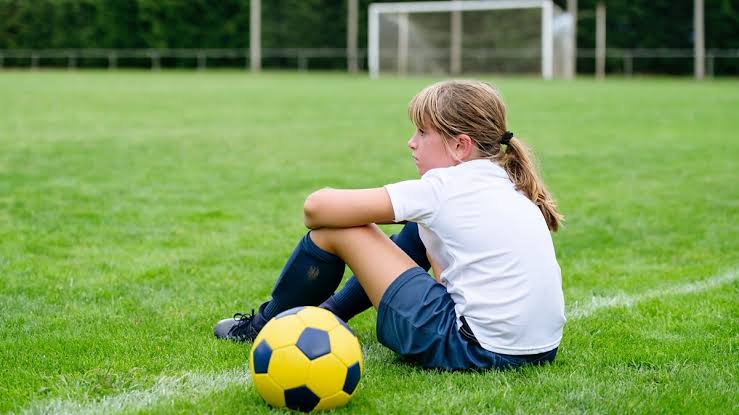
By the time a girl turns 14, she is twice as likely to have quit soccer as the boy who grew up playing beside her. The sport that once defined her Saturdays, that gave her a team, a role, a reason to lace up boots in the dark of early morning, has already started to feel foreign.
Not because she lost interest. Not because something better came along, because somewhere in the overlap of a changing body, a changing social world, and a youth soccer system that was largely built with male physiology in mind, the sport stopped making room for her and she walked away without anyone adequately understanding why.
That is the crisis hiding in plain sight at clubs across every continent.
The Women’s Sports Foundation has the data to confirm what coaches already sense in their guts: girls abandon sport at twice the rate of boys by age 14, a disparity that has barely shifted despite decades of advocacy, growing professional women’s leagues, and the commercial surge of the women’s game at its elite levels.
In February 2026, a survey of more than 1,500 parents and players conducted by i9 Sports gave the crisis fresh texture, revealing that girls are not just drifting away but being pushed out through a combination of body image pressure, reduced enjoyment, inadequate opportunities, and coaching environments that were never designed to serve them.
The gap between what youth soccer could be for girls and what it currently is sits right in the middle of puberty, somewhere between 11 and 14 years old, and closing it is the most important work any club serious about the women’s game can take on.
What Puberty Does to a Young Players

The physical changes of female puberty are not gentle.
Between 10 and 14, girls experience widening hips, increased body fat distribution, the onset of menstruation, and dramatic fluctuations in estrogen and progesterone that alter everything from mood and energy levels to ligament laxity and bone density.
The body a girl has trained in for years begins to feel unfamiliar, and the movement patterns she spent thousands of hours building start to misfire against the new architecture of her frame.
Research published in Frontiers in Sports in 2025 identified puberty as one of the central contributing factors for girls dropping out of soccer during adolescence, noting that the gap in knowledge about these changes, among players themselves, among coaches, and across club structures, compounds the problem significantly.
Female athletes reported limited understanding of the biopsychosocial dimensions of puberty-related changes and their effects on performance and wellbeing, a void that makes every difficult training session feel like personal failure rather than a physiological transition with a coherent explanation.
The injury dimension of this transition is particularly acute in soccer.
Studies have consistently shown that female players are substantially more prone to ACL tears than male players playing the same soccer, with the risk rising sharply during and after puberty as hormonal fluctuations increase ligamentous laxity and the growing body’s longer femur and tibia create greater mechanical torque at the knee during cutting and landing movements.
Data from the 2022 and 2023 FIFA World Cups found that 12.5 percent of all women’s players in the tournament had previously undergone ACL reconstruction, compared to 7.7 percent of men.
FIFA has since funded research through Kingston University in England specifically investigating the link between menstrual cycles and ACL injury rates in women’s football, a long-overdue institutional acknowledgment that the female body in sport requires its own science.
For a 13-year-old midfielder who suddenly starts getting knee pain, who feels slower than she was last season, who finds that heading the ball or making sharp turns feels different and harder, there is rarely anyone in her club environment who can explain what is happening to her body or how to train through it safely.
The silence itself becomes a reason to stop.
CHECK OUT | Youth Soccer Passing Warm-Up Drill for Better Team Play
The Body She Is Learning to Hate
The physical changes of puberty do not happen in a vacuum. They happen on a pitch, in a locker room, under the eyes of a coach, alongside teammates who are all going through the same changes at different speeds and with radically different levels of support.
They happen in the same years that social media becomes the dominant arbiter of what a girl’s body should look like, a standard that is almost perfectly incompatible with what a high-performing female soccer player’s body actually needs to be.
Research from Women in Sport, one of the UK’s leading advocacy organizations, has found that 64 percent of girls will have quit sport by age 14, and that fear of failure accounts for a substantial portion of that departure.
Half of girls aged 14 to 16 reported feeling paralyzed by the fear of failure at puberty, preventing them from trying new things.
Eight out of ten girls with low body esteem said they actively avoided putting themselves in front of peers or trying out for teams. And 29 percent of girls aged 14 to 16 who stopped playing competitive sport said they felt they simply were not good enough, a belief rooted less in objective ability than in the destabilizing self-perception that puberty produces.
The uniforms do not help.
Over the past decade, youth soccer kits have become considerably more form-fitting, even at U12 level, an aesthetic shift borrowed from the professional women’s game without accounting for the developmental vulnerability of girls who are already hyperaware of their changing bodies.
A girl who gained weight during her growth phase, whose hips widened before her teammates’, who is wearing a tight synthetic jersey in front of a crowded touchline on a Saturday afternoon, is going through a social pressure that her male counterpart just does not face in the same way.
The sport should be absorbing that pressure. Mostly, it amplifies it.
A 2025 study published in the journal Frontiers in Sports examining the knowledge gaps of female athletes found that girls were receiving almost no structured education from their clubs about what puberty would mean for their bodies, their performance, or their nutritional needs, leaving them to assemble a picture from social media, peers, and the broader culture, sources far more likely to communicate anxiety than understanding.
The Coaching Gap
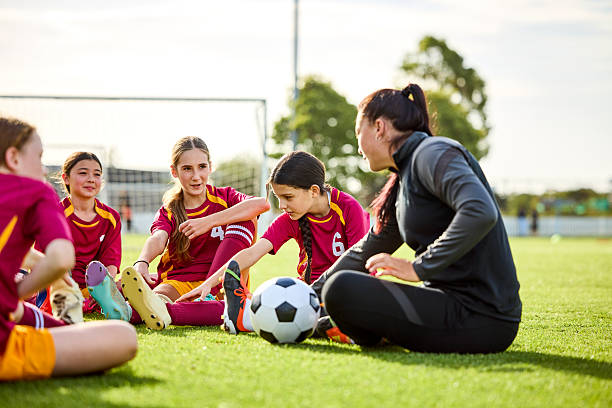
Youth soccer coaching has a fundamental problem when it comes to adolescent girls, and it extends well beyond individual coaches making careless comments about weight or fitness.
The architecture of coach education itself has been built predominantly around male physiology and male developmental timelines, leaving coaches without the tools to recognize, understand, or respond to what their female players are experiencing during the most disruptive years of their athletic lives.
A study examining dropout behavior among adolescent soccer players found that lower levels of autonomy support from coaches were a primary predictor of girls leaving the sport, a finding that speaks to something deeper than tactics or drills.
Girls in the dropout-risk group consistently described feeling that their experience on the pitch mattered less to their coaches than their output, that moments of physical struggle or performance dip during puberty were read as effort deficits rather than biological realities, and that the emotional texture of what they were going through never entered the conversation at training.
The Her Strength Coach Course, launched specifically to address puberty in coaching education for adolescent female athletes aged 12 to 18, was built out of the recognition that this gap is structural, not incidental.
The course covers physiological changes during puberty, how to adjust training loads based on those changes, nutrition, body image, and psychological wellbeing, content that is currently absent from most national federation coaching licenses at the youth level.
That a private provider had to build this course is itself an indictment of where the sport has invested its attention.
What coaches say and do not say in the presence of pubescent girls carries enormous weight.
Research from the Beautiful Project, a US-based initiative examining coaching behaviors in girls’ soccer programs, found that coaches who made appearance-related comments during training, even casual or well-intentioned ones, produced measurable drops in confidence and participation willingness among female players aged 11 to 14.
A single comment about a girl’s body, made in front of her teammates, can end her career in that club, sometimes in the sport altogether.
The coaching conversation that girls actually need during this period centers on explaining rather than evaluating: explaining why a performance dip in the early stages of a growth spurt is expected and temporary, explaining why certain movement patterns feel different, explaining how nutrition supports a changing body rather than controls it, and explaining that the uncomfortable phase they are in has a logic and an end point.
CHECK OUT | How to Run a Perfect 7v7 Soccer Scrimmage for Youth Teams
The Roster Spot Problem
The structural barriers compounding all of this are not subtle.
Girls have more than 1.3 million fewer roster spots on high school and college teams than boys in the United States, according to Women’s Sports Foundation research, a disparity that means girls who want to continue playing competitive soccer often have to pay for private leagues, travel teams, and academy programs that are financially inaccessible to large portions of the population.
The sport’s response to losing girls has partially been to create more expensive pathways, which does not solve the problem of who gets to stay.
In a 2022 longitudinal study tracking nearly 10,000 female soccer registrations across seven years in Ontario, Canada, researchers found that competitive players were significantly more likely to remain in the sport compared to recreational players, with retention rates of 55.9 percent versus 20.7 percent respectively.
That finding seems to suggest that higher-level programs are stickier, but it also reflects the fact that clubs invest disproportionately in their elite tiers, creating better coaching, better infrastructure, and better environments at exactly the level that filters out the majority of girls during their most vulnerable developmental window.
The girls who most need an excellent experience are the ones most likely to be in under-resourced recreational programs where the coaching is thin, the kit is ill-fitting, and no one has thought carefully about what U13 girls actually need.
In Swedish soccer, participation peaks around age 12 and then drops sharply and consistently through the following years, with the steepest decline falling between 13 and 17, the period that maps almost exactly onto the years when puberty is at its most disruptive.
That is not a coincidence. It is a structural failure dressed up as natural attrition.
What the Research Says Clubs Can Change
The gap between knowing why girls drop out and building programs that prevent it from happening has been narrowing, slowly, through a combination of research initiatives, advocacy campaigns, and clubs willing to do the difficult organizational work of redesigning how they serve female players.
In December 2025, US Soccer announced the launch of the Kang Institute, funded by a $30 million donation from billionaire Michele Kang and focused specifically on addressing the research and training disparities that have left generations of female soccer players working within programs built for male bodies.
The institute’s inaugural research agenda covers injury prevention, mental health, workload management, menstrual health, and the transition from youth to elite competition: a blueprint that reads like a map of every point where adolescent girls have historically been failed. Georgie Brunvels, female health and research innovation lead with US Soccer, has spoken directly about the global stakes of the work, noting that what happens in soccer will shape how the broader sports world begins to listen.
UEFA has been advancing its own menstrual health research agenda through its Medical Symposium program, bringing together the latest science on hormonal influences in women’s football and how clubs can build more responsive training environments around them.
The science on whether specific menstrual phases produce measurable, consistent changes in injury risk remains contested and evolving, but the institutional attention itself signals a shift in whose physiology is considered worth understanding.
The Norway model offers a longer-term template.
The country’s Children’s Rights in Sport framework, which emphasizes enjoyment, autonomy, and skill development over results at early developmental ages, has produced some of the highest youth sport retention rates in the world, with 93 percent of children remaining active in at least one sport under its model.
Norwegian Football Federation data showed that by 2020, nearly 90,000 of the country’s 270,000 active soccer players were female, a proportion that reflects years of prioritizing early-stage experience quality over competitive selection pressure.
Clubs that have reduced female dropout rates in adolescence consistently share a set of practices that are less complicated than they might appear.
Coach education mandates around female physiology and puberty, so that every coach working with U12 through U16 girls has a working understanding of what their players are experiencing biologically, form the bedrock.
Creating spaces where girls can ask questions about their bodies and their performance without shame, which means coaches who signal openness rather than discomfort when those conversations arise, comes next.
Adjusting training loads during the early growth phase rather than punishing players for apparent performance drops is not a concession: it is developmentally appropriate coaching that keeps athletes in the sport long enough to realize their potential.
Uniform policy is a more immediately actionable intervention than it might seem. Clubs that have moved to offering multiple kit options, including less form-fitting alternatives for younger female age groups, report that girls attend training more consistently and express greater comfort participating in physical drills.
The resistance to this shift within club structures tends to come from aesthetics and tradition rather than any compelling reason rooted in the girls’ experience, which says a great deal about whose comfort the tradition was built to serve.
The i9 Sports campaign launched in 2026 under the banner “Gains are for the Girls” set a target of 500,000 girls playing annually by 2030 and centred its methodology around creating environments where the pressure has been removed and the experience itself is the point.
The framing is deliberately simple: many girls are not quitting because they no longer care about sport but because the joy has been squeezed out by judgment, anxiety, and social pressure.
The campaign echoes findings from Women in Sport, which in research involving more than a million teenage girls found that 59 percent of those who had been sporty still liked competitive sport, but had been failed by the environment rather than their own ambition.
CHECK OUT | Soccer Scholarships in the USA: How to Apply and Get Accepted
The Window That Closes
There is a practical urgency to this that the youth soccer world has been slow to internalize. Girls who drop out of soccer during puberty rarely come back to the sport as adults.
The research on dropout across adolescent sport is consistent on this point: the window between 11 and 14 is not simply a difficult phase to manage but a decision point that tends to be final. The clubs that lose girls in that window are not just losing current players.
They are losing coaches, referees, administrators, and parents who might eventually have built the game from within, a cascading cost that compounds silently over decades.
Neuromuscular training programs, introduced specifically in the years leading into puberty to address the biomechanical shifts that make female players more vulnerable to lower-limb injuries, have been shown in multiple studies to reduce ACL injury incidence substantially when implemented consistently.
A 2024 meta-analysis confirmed that as female players reach their mid-teens, sports-related ACL injuries continue to increase in frequency, and that the optimal window for neuromuscular intervention is precisely the early adolescent years before the riskiest biomechanical transitions are fully established.
Clubs that wait until a girl is injured to address her injury risk have already missed the moment.
The retention data from soccer’s own research makes the argument in numbers.
In the Ontario longitudinal study, the median survival rate for female players in the most common birth-quarter groupings was just three years from their initial registration. Three years.
A girl who falls in love with the game at ten has, in the current system, roughly even odds of still playing by the time she is 13. That is not a talent pipeline problem. It is a design problem.
The Obligation Clubs Actually Have
The most honest version of this conversation requires clubs to sit with a difficult truth: the girls who drop out during puberty are not failing the sport. The sport is failing them, and it has been doing so consistently enough and at scale enough that it cannot be explained by individual bad actors or isolated poor decisions.
It is systemic, which means the fix has to be systemic too.
What that looks like in practice is a club that treats female athlete development as its own discipline rather than a version of male athlete development with softer language layered over the top.
It looks like coach education programs with mandatory content on female physiology, on the nutritional needs of adolescent girls in growth phases, and on the psychological pressures that make the pitch feel unsafe for a girl who is not certain her body belongs there.
It looks like retention metrics that clubs actually track and take seriously, the way they track goals scored or academy graduates, rather than treating dropout as background noise.
The women’s game at its elite level has never been more visible.
The 2026 FIFA World Cup has placed women’s soccer in front of a global audience that is larger and more invested than any previous generation, and clubs everywhere are correctly reading that visibility as an opportunity to grow. But the pipeline that feeds elite women’s soccer starts on a Sunday morning pitch with a 12-year-old who is starting to feel like her body has betrayed her and who needs someone in her club to tell her, with knowledge and with warmth, that it has not.
The girls who stay in soccer through puberty tend to become the kind of players who carry the sport forward for decades.
The ones who leave tend to carry a silent, specific kind of grief, the sense of a door that closed before they understood it had been closing.
Keeping it open is not a complicated mission. It requires attention, education, and a genuine reckoning with whose experience has historically shaped the game and whose has not.
The clubs that reckon with it now will have rosters full of women in 15 years. The ones that do not will wonder where all the girls went.