High press is everywhere now. Every team above Sunday league has a version of it. Some run a coordinated gegenpressing system straight out of Klopp’s playbook. Others just chase in packs the moment they lose the ball.
Either way, if you have not prepared your team to deal with it, you will spend significant chunks of your matches looking panicked, giving the ball away in dangerous areas, and wondering why your shape keeps falling apart.
This guide is not about theory.
It is about the actual steps you take in training, in your setup, in the moments during a match to make a high press look beatable.
Not complicated. Not impressive on a tactics board. Just functional and repeatable.
What a High Press Is Trying to Do to You
Before the steps, take thirty seconds to understand the mechanism.
A high press does not just want the ball back. It wants to compress your decision time so badly that you make bad choices under pressure. The pressing team wins the ball. They get a turnover close to your goal. That is the system.
But even when they do not win the ball, they are succeeding if your goalkeeper panics and kicks it long and aimlessly, if your centre-back rushes a pass into the feet of an already-marked midfielder, if your full-back smashes it into touch because he had no other option.
Every press has a trigger.
A goalkeeper receiving a back pass. A centre-back receiving side-on with limited vision. A holding midfielder checking short into a crowded area. The pressing team has rehearsed exactly which moment to spring from. They are not chasing. They are waiting for you to hand them the key.
Know the trigger. Remove the trigger. That is the whole game.
CHECK OUT | How to Prevent Burnout in Female Soccer Players: 10 Helpful Tips
Step 1: Build a Shape That Gives You Passing Options Before the Ball Arrives
This is the most important step and the one most coaches spend the least time on. When the ball is with your goalkeeper or your deepest defenders, where is everyone else standing?
If you have not answered that question before the season starts, you are going to be improvising under pressure every week.
The goal is to give the ball carrier at least two clean passing options at all times. Not one. Two.
Because a press is specifically designed to take away one option and leave you with only the second one, which they will then sprint to close down. If you only ever have one option, you are always being herded.
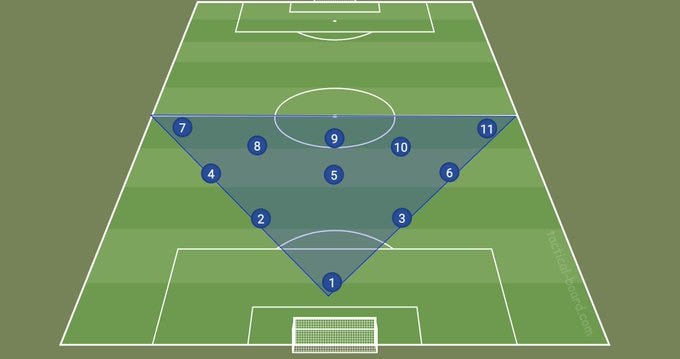
The practical shape that works best for building out against a high press looks like this. Your two centre-backs split wide toward the edges of the penalty area. Your holding midfielder drops between them, essentially turning a back two into a back three temporarily.
This overloads the first pressing line and forces the opponent to commit an extra player just to outnumber you at source. Meanwhile, your full-backs push higher and wider than usual, providing the wide passing lanes. Your number 8s position themselves on the half-turn in the space between the opposition’s press and their midfield block, ready to receive and immediately play forward.
What you have built is a structure where the ball can always move somewhere before the press fully closes. The press needs to cover six or seven positions simultaneously.
It cannot. Somewhere is always open.
Step 2: Coach Your Goalkeeper to Be a Playmaker, Not a Distributor
The goalkeeper is the most important player in your anti-press system. Not because of shot-stopping. Because he touches the ball first, under the least pressure, and sets the tone for everything that follows.
A goalkeeper who receives a back pass and immediately hoofs it long has solved nothing. He has just relocated the problem 50 metres up the pitch where his team has less structure and less support. Sometimes that is the right call.
Most of the time it is panic wearing the disguise of decisiveness.
What you actually want your goalkeeper doing is scanning before the ball even arrives. Looking left. Looking right. Identifying which centre-back has more time, which full-back is in space, whether the pivot has dropped to provide an angle. By the time the ball reaches his feet, the decision should already be made.
Ederson was doing this for Manchester City in their best years. One direct pass from him to a forward making a perfectly timed run in behind completely bypassed Newcastle’s entire pressing structure.
Newcastle’s aggressive man-to-man marking left them completely exposed to the one pass that took everybody out of the game. The goalkeeper found the free man. Eleven Newcastle players became spectators.
Train your goalkeeper on this specifically. Put your team under a press in training. Have the goalkeeper call the outlet before playing.
Build the habit of scanning first, touching second, playing third.
CHECK OUT | How to Run a Perfect 7v7 Soccer Scrimmage for Youth Teams
Step 3: Use Width to Stretch the Press Thin
A pressing team’s worst nightmare is a pitch that feels like it is 80 metres wide. Their best friend is a team that stays narrow and makes the press easy to organise.
Make the pitch big.
Ask your widest players to hug the touchline when your team is building from the back. Full-backs stay wide and push the pressing winger back toward their own position. Wingers stay in advanced wide positions, pinning the opposition full-backs and creating a long diagonal option whenever the ball needs to escape pressure quickly.
This matters for two reasons.
First, it gives you a release valve that the press struggles to close down fast enough. A switch from the goalkeeper to the right centre-back to the right full-back who receives in space out wide that chain of three passes moves the ball 25 metres across the pitch and the pressing team has to sprint to reorganise.
They are always half a step behind.
Second, it tires the pressing team faster. A press that has to cover the full width of the pitch demands huge physical output.
If you consistently find your wide outlets, the pressing team’s energy degrades well before the 70th minute. Teams that survive the first 20 minutes of a high press with their shape intact very often win the final quarter of the match simply because the pressing team has run out of legs.
Step 4: Identify the Press Trigger and Remove It
Go back to that word: trigger.
Every pressing system has one. Your job in preparation is to find it and make sure your team never accidentally gives it away.
Watch video of your next opponent.
When do they press?
What moment causes their front three to suddenly sprint?
Usually it is one of these: a goalkeeper receiving a back pass under no immediate pressure, a centre-back receiving side-on with their back to the pitch, a midfielder checking short into a crowded lane with no forward option available, a goal kick being played short straight into the feet of a player who is already being watched.
Once you know the trigger, build a rule around it.
If it is the back pass to the goalkeeper, tell your players never to play back to the goalkeeper unless he has a clear option already identified. If it is the side-on centre-back, coach them to receive on the half-turn, body open, already facing up the pitch.
If it is the crowded midfielder, give him a rule: if there is no clean forward pass available in the next two seconds, play back or switch wide rather than holding.
Pressing teams rely on teams being disorganised and reactive. When you remove the trigger, the press never fully fires. Their front three run half-heartedly at your back four, get no reward, and gradually disengage.
CHECK OUT | How to Deal with Gossip and Toxic Behavior from Soccer Parents
Step 5: The Third-Man Combination to Beat the Press
This is the most effective in-play tool for actually breaking out of a press once it has started closing around you. Third-man combinations are sequences of two quick passes that draw the press toward one player and then bypass it by playing immediately to a third player who arrives late into space.
It works like this.
Your left centre-back has the ball. The opposing right winger sprints to press. Your left centre-back plays it quickly to the pivot in the middle.
Two pressing midfielders move toward the pivot, collapsing the central passing lane. The pivot plays first-time back to the right centre-back, who has held their position and now has a clean run of space in front of them because the press has shifted left. Three passes, and the press is now completely on the wrong side of the ball.
Coach this in training with small-sided rondos under live pressing.
The key is the timing of the third player’s movement. They cannot start running early or the pressing team tracks them. They wait until the press has committed to the second player, then arrive into the space the press has vacated. The movement must be sharp and late.
This takes repetition. It will not work the first time your team tries it under match pressure. But after twenty sessions of it, it becomes instinct.
Step 6: Long Diagonal Switches to Punish Overcommitted Presses
When the press fully commits to one side of the pitch, the other side is open.
Your players need to have the confidence and the technique to switch the ball quickly and accurately from one side to the other, bypassing all of the pressing traffic in between.
The key instruction is simple.
If the press traps you on the left, the answer is on the right. Every time. No hesitation. Your goalkeeper, your centre-backs, and your holding midfielder all need to be technically capable of playing that long diagonal accurately under pressure, because the window to play it is short.
Brighton under Fabian Hürzeler turned this into one of the most effective anti-press tools in the Premier League. They deliberately emptied their midfield, drawing the press to commit into a narrow central area, then found the goalkeeper or the deep centre-back in space with time to play a long diagonal forward.
When that ball bypasses the press, Brighton create a numerical advantage in the final third and Chelsea’s pressing players are caught completely out of the game.
The forward who receives the diagonal switch needs to be coached to receive at pace and attack the space immediately. This is not the moment to take a touch and settle. The press is disorganised for about four seconds after the switch. Those four seconds are the attack.
CHECK OUT | How to Build Stamina and Endurance: 10 Tips for Soccer Players
Step 7: Going Direct When the Press is Highest
Sometimes the cleanest answer is the most direct one. When the opposing press is at its most intense and most organised, the space it always leaves is directly in behind the pressing line. Their defenders are pushed high. Their midfielders are pressing forward. There is grass behind them.
A runner in behind, timed to move the moment the goalkeeper receives the ball, can be on the shoulder of the last defender before any pressing player has time to recover. One pass over the top of the press. Done.
This is not lumping it. This is deliberate tactical directness used as a specific weapon against a specific vulnerability. The press wants you to play short and get trapped. Going long surprises them. The key is that the runner must time the run precisely — too early and they are offside or the pressing team tracks them; too late and the goalkeeper has been forced to play elsewhere.
Pair this with the short build-up options described above and you have a system that the pressing team cannot solve. If they hold their defensive line to cover the run in behind, your short build-up succeeds. If they push their defensive line up to press aggressively, the ball goes over the top.
They cannot defend both. Make them choose.
Step 8: Managing Tempo and Composure Under Pressure
Everything above is mechanical. This step is mental, and it matters just as much.
Pressed teams panic.
They rush first touches. They choose the difficult pass over the simple one. They play too fast in the wrong moments and too slow in the right ones.
The press feeds on panic. Without panic, the press is just eleven people running a long way for no reward.
The most important thing you can coach is this: slow the touch down. Not the thinking, not the scanning, not the decision. The touch. A controlled, cushioned first touch that sets the ball exactly where you want it for your next action gives your players a fraction of a second more than the press expects. That fraction is everything.
In training, reward composure explicitly. When a player receives under pressure and plays a calm, accurate pass, acknowledge it. When a player panics and clears it unnecessarily, stop play and reset. The culture of calm under pressure is built in training before it appears in matches.
PSG demonstrated this in their Champions League second leg against Bayern Munich this season. After a chaotic 5-4 first leg, they slowed everything down in the return, played with only 27 percent of the ball at times in the second half, and were completely comfortable.
They refused to engage with the press. They controlled tempo deliberately. Their calmness made Bayern’s press useless.
Calm is a tactical weapon. Coach it like one.
Putting It All Together on Match Day
None of these steps works in isolation.
The shape in Step 1 gives your goalkeeper the options in Step 2. The width in Step 3 creates the diagonal switch in Step 6. The third-man combinations in Step 5 keep the press guessing so the run in behind in Step 7 comes as a genuine surprise.
Before a match against a pressing team, walk your players through the opponent’s triggers. Show them the specific moment this team likes to press from.
Give them the rule they need to remove that trigger. Remind them that width is their friend, that composure is their weapon, and that the press always creates a free player somewhere. Their job is to find that player before the opponents finish organising.
In 2025-26, the teams who dealt best with high-pressing opponents were the ones who prepared the most specifically. Opponents increasingly bypassed Liverpool’s high press with direct progression, repeatedly exposing the vulnerabilities of Slot’s approach.
PSG refused to engage with Arsenal’s press, stopped playing through the thirds, and went extremely direct, proving they had become a more tactically versatile outfit.
The press is not magic.
It is a system with real, exploitable weaknesses. Find those weaknesses in preparation, rehearse the solutions until they become second nature, keep your players wide and your goalkeeper scanning, and stay calm when it starts closing around you. That is the whole thing. Every single time.
CHECK OUT | How to Deflate a Soccer Ball: A Practical Guide